
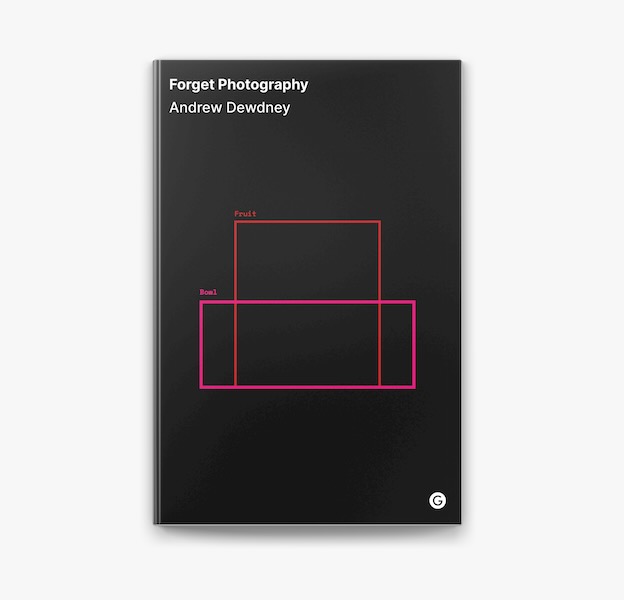
This book has a simple, clever, disquieting cover. The book’s author, Andrew Dewdney, believes that the paradigm of photography can no longer explain what he calls «the networked image» — images generated by computers, images made to be used by computers, images produced and used by people whose uses are not aesthetic, etc. Photography can’t account for the central role of this new type of image in constructing capitalism, white supremacy, and patriarchy. As the book’s title proclaims, Dewdney urges us to forget photography. He does not mean to erase photography but to denaturalize it as a critical and historical principle, looking for alternative paradigms to deal with the networked image. One of the central arguments of «Forget Photography» is that photography is dead. It survives as a zombie, limiting our ability to understand the present moment and forcing us to look at it through the lens of photography and art. On the book’s cover, the two rectangles tagged “fruit” and “bowl” are a still life as seen by an artificial intelligence system, a classic theme of art history recreated by an inhuman vision. The picture perfectly illustrates the argument.
Looking in depth at the image of this cover leads to questions about design that go beyond the book’s scope. I read «Forget Photography» in the ebook version. To illustrate this article, I combed the Internet for a photograph of a physical copy. In the search engine, almost all the results were unmistakable digital images, rectangles without thickness or evidence of matter. A single picture, which I chose to illustrate this text, seems to present the book as a physical object. However, something is amiss: the uniformity of the shading and the brightness of the spine’s fold point to a simulation. There are services on the Internet that automatically create a picture of a physical book from the cover file. Students use them to mock up the publications they design in my classes. Nowadays, most designers work with the help of all kinds of algorithms. Programs like InDesign or Illustrator automate everything from optical alignment to managing line breaks in paragraphs. Even if this image is a photograph, a computer program adjusted its color and corrected the lens distortion. Designers work in a place where humans and machines merge. Is the cover image of «Forget Photography» the output of an AI system? Is it a design object without a designer? Or a designer simulating the design of a machine? It is hard to ascertain without reading the credits.
The doubts enunciated in “Forget Photography” also plague design as a discipline. If it is possible to doubt photography’s usefulness as a paradigm, one could argue the same about design. It has become commonplace to decry the profusion of unregulated uses of the word “design.” Every month, I read or hear a designer bemoaning the overabundance of design. This excess resembles the profusion of images that increasingly eschew the paradigm of photography. It has comparable causes. Designers rarely express their disciplinary doubts in the same way that Dewdney articulates those of photography. Here’s an attempt: with design being almost automated and present everywhere in radically new ways, does it make sense to keep calling it “design”? Can design as a discipline explain or even enumerate this glut of designs? The answer to both questions may be no. However, imagining alternative paradigms for design is more complex than for photography. One cannot even resort to an alternative and broader concept, such as the image. “Design” is both a professionalized subject area and, at least in English, the more general act of designing or conceiving. It can, by itself, play roles similar in scope to “photography,” “picture,” and “image.”
However, we can look freshly at “design” from the periphery, where its totalizing ambitions are less fixed. The word “design” is a recent addition to the Portuguese language. It does not even have a verb equivalent. It is an object and a subject but not an action. The discipline is also relatively new. It was challenging to establish it in Portugal. There have been numerous acts of resistance — printers who saw their activity threatened, those who refused to use the English word “design,” etc. The idea that design is an eternal and inherently human activity ignores these resistances. Under the pretext of expanding the history of design, ruptures and transitions are forgotten. Design critics and historians shouldn’t erase these if the goal is to decolonize design and expose its capitalist roots. It is essential to forget design, if only for a moment — to see a whole range of practices not as potential appendages of design but as alternative paradigms with their coherence, methods, politics, and identities.
What does it mean to forget design? To ask, for instance, what the world or the present moment would be without design. Graphic design as a discipline has followed the opposite path. While designers complain about the unregulated use of the word “design,” they apply it to increasingly remote artifacts. Everything becomes Design — an illuminated book, a papyrus, or the ornamentation on a prehistoric spear. In the name of disciplinary unity, the history of graphic design smoothes out discontinuities and ruptures. One of them, hidden in plain sight, separates Image from Graphic Design. The latter has become almost synonymous with typography. Design only accepts the image as a complement to the text. Or as a corporate image. Design may no longer want anything to do with the image. It is concerned, above all, with the visuality of the text. It often rejects objects without text — a poster or a publication — as not being design at all.
But there were occasions when the designer was also a producer of images. Laszlo Moholy-Nagy proposed the future of design as the fusion of typography and photography, which he called Typohoto. Letters and pictures would be like indifferent pixels on the page. The design magazines and books of the mid-20th century were full of reflections on the image. From Moholy-Nagy to Josef Müller Brockmann, all produced thoughts on the image, not only in the sense of content but as something made and worked on by designers.
A central preoccupation with function is one of the main differences between design and art. Design’s abandonment of the image signals resistance on its part to think about the functions of the image. One consequence is treating the image as external content rather than something whose primary functions designers can decide.
There was a time, during Modernism, when the image was a design object. In the 1920s and 1930s, some news magazines were printed using rotogravure, a technique where the entire page, including the text, was produced using photographic processes. Designers planned these publications as photomontages. Photographers would take pictures with their final place and function in the composition in mind. The design process dictated the framing, the angle, the staging, and even the image cropping. Photography was not content. It was an integral part of the design process. Today, designers treat the image as one more rectangle in the middle of the text frames. There is a division of tasks: design takes care of the visuality of the text and the elements that interact with it; photography (or illustration) takes care of the image. Design’s rupture with image derives from a need to redefine itself. This reappraisal is partly due to the need to isolate design as a discipline from art and photography. Dewdney states that the survival of photography as a paradigm is also due to the growing compartmentalization of the fields of knowledge in universities. Design, art, and photography maintain their autonomy to ensure the independence of their respective faculty departments.
Dewdney criticizes this disciplinary entrenchment. His solution — to forget photography — makes it also possible to forget design. That does not mean erasing it; instead, it means becoming aware of design as an object subject to history and not a constant. The history of design should also be the narrative of how it radically changed as a concept. There is an effort to make histories of design concerned with presenting design as dependent on different technical, social, and formal contexts. However, the idea of design as a constant implies that, from these conditioning factors, the same dominant concept of design always emerges. To challenge this hegemony, it is essential to go back and reexamine graphic design’s core tenets. One of them, perhaps the most central, is its contradictory claim to visuality. As often said, good design is visual communication, but the best should be invisible. Present but forgotten.


Leave a comment