
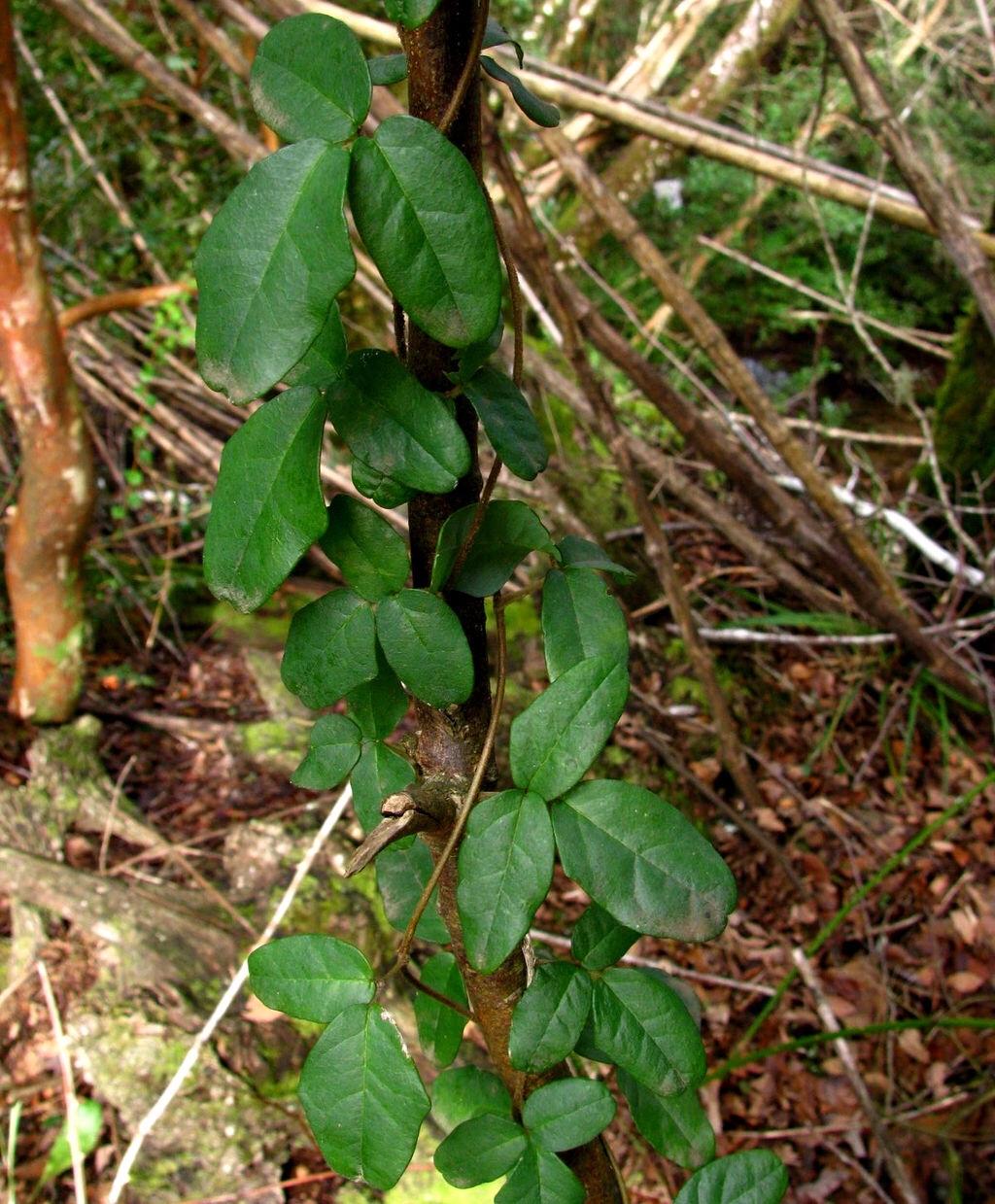
Boquila trifoliata is a climbing vine that mimics the appearance of plants around it. Scientists are trying to figure out the process behind this mimicry. Can this vine be sensitive to chemicals or even DNA collected from nearby plants? Surprisingly, experiments showed that the vine could also replicate plastic plants. Somehow, it can “see” its surroundings and use this information to change its appearance.
Discovering how this plant senses its environment requires us to imagine a profoundly non-human mode of vision. Traditional notions of sight may not even be helpful. Looking for eyes, retinas, or other equivalent forms of darkroom may not make any sense. One might entertain, for instance, the possibility of a distributed photosensitivity or some sensitivity to shadows. It could be that the process doesn’t involve visible light at all.
In another text, I discussed Paragraphica, the project of a “photographic” machine that uses AI to produce images from online data about the device’s location. This “camera” highlights the artificiality of the very idea of photography, showing how it is not a natural and unmediated way of apprehending reality but a construction resulting from a set of cultural, social, political, and technical decisions and limitations.
Understanding non-retinal and non-human modes of photographic perception challenges our relationship to images. This endeavour demands that we extend the notion of image beyond the traditional boundaries of photography.
Radically rewriting the idea of image should lead to a profound reassessment of graphic design. This discipline relies on core concepts, like form, function, or image, yet these ideas often remain unquestioned. These principles are not natural, timeless and unchanging but products of specific historical contexts. So is graphic design.
We shall delve into the complex and troubled relationship between graphic design and images in future texts.
 Unseen by Design
Leave a comment