
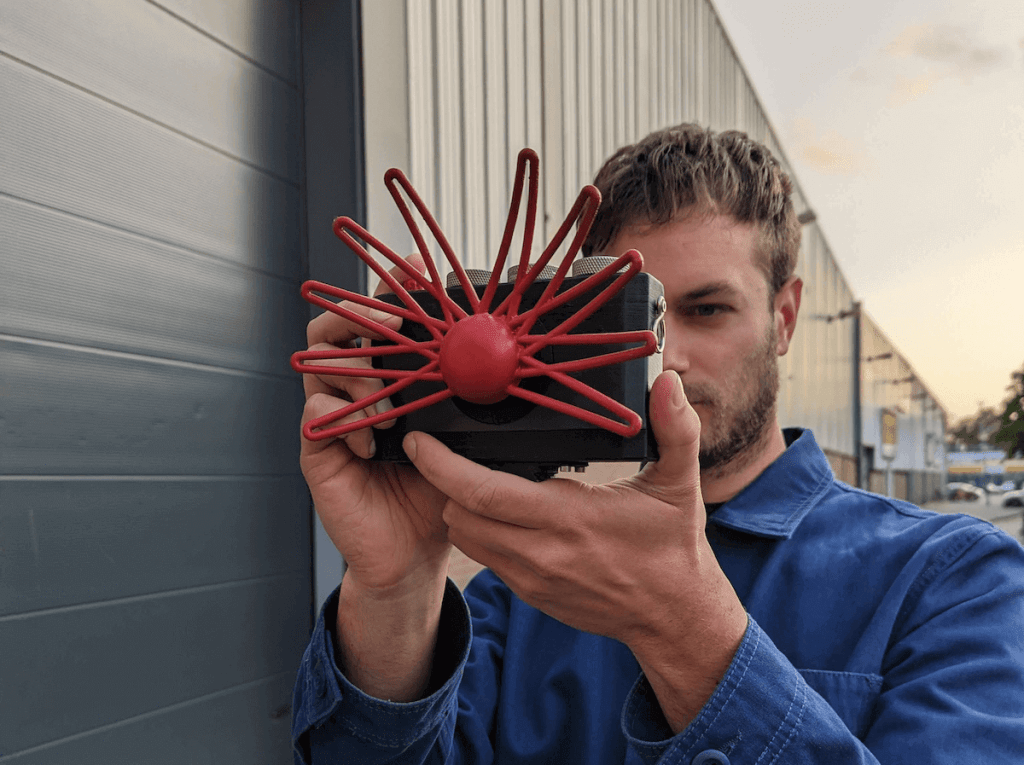

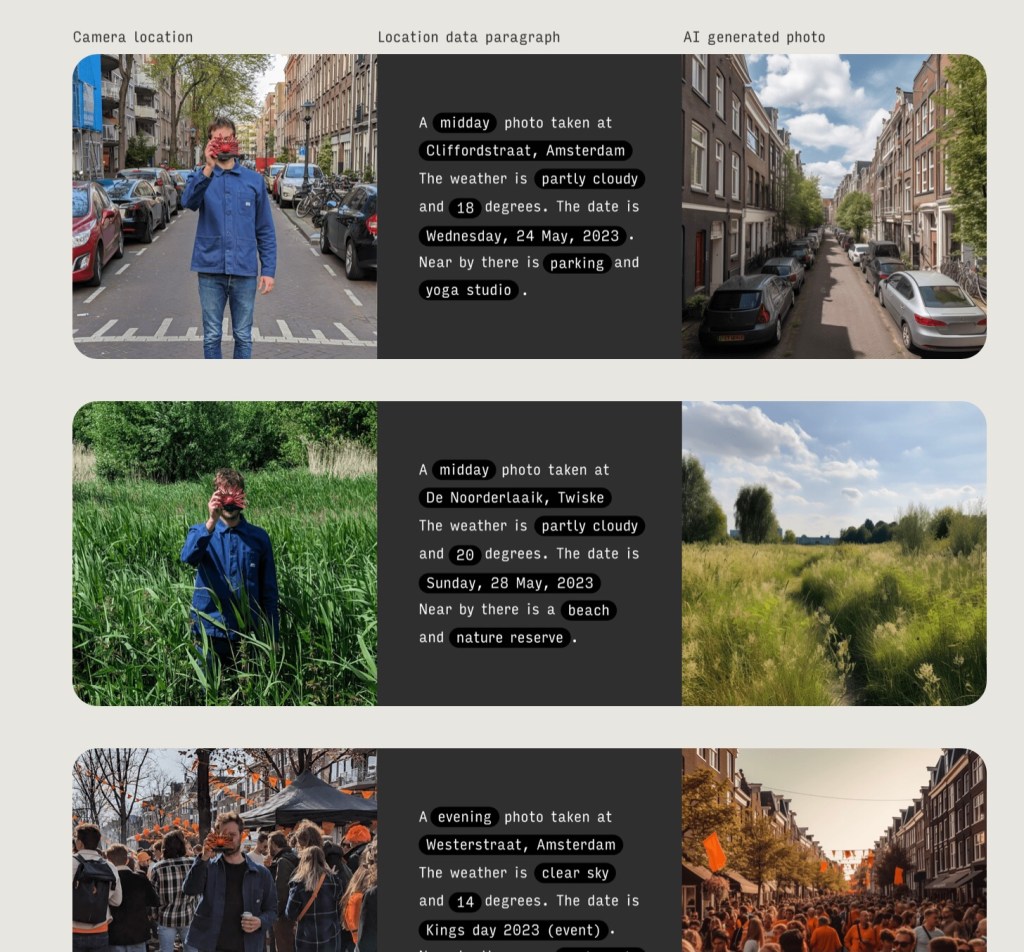
Paragraphica is a device developed by Bjørn Karmann. Resembling a photographic camera, it doesn’t have a lens. It’s a context-to-image camera: it gathers online data about its location and feeds it to an AI to create pictures.
The most invisible lesson of this lens-less camera is not about artificial intelligence but about photography. We still see photography as something authentic. Light passing through the lens and registered by a sensitive material is seen by many as the final stronghold in the losing war for a pure perception, not constructed and not simulated.
This “unseeing” camera reveals the photographic device’s arbitrariness. It shows what it has of construction and what it has of simulation. (In recent years, there has been a rather exciting tendency to deconstruct photography in the digital image’s light — pardon the pun.)
The classic photographic device is not a certainty. It is the result of choices made by people according to their own biases. The standard photographic lenses make images that resemble those produced by the linear perspective developed during the Renaissance. We can speculate what the discipline of photography would be without the invention of linear perspective.
Perhaps tilt shift objectives, which move the lens while recording the photo, would become dominant. People and buildings would resemble miniatures, somewhat like the paintings of Bosch or Brueghel. Tilt-shift lenses show what could perhaps be medieval photography.
Imagine that in photography’s early days, only chemicals that recorded the infrared range were available to the first inventors. Photography would then be thermography. Imagine night images of hot bodies and objects.
Or, better yet, imagine a culture that would value the invisible and the unseen. Or one that preferred night or twilight to the light of day. Imagine photography made by a culture of vampires. Or mole-people. Perhaps the result of photography would not be a flat surface but a tactile sculpture.
Returning to our universe after this incursion through alternative photography, the artificiality of the photographic device becomes visible, its character as a cultural construction. We realize, for example, how photography is not neutral but is tuned to reproduce white skin. We understand that photography does not correspond precisely to the spectrum of what a human sees, neither in terms of tonal range, framing, or color.
 Unseen by Design
Leave a comment