
A nostalgia of my own
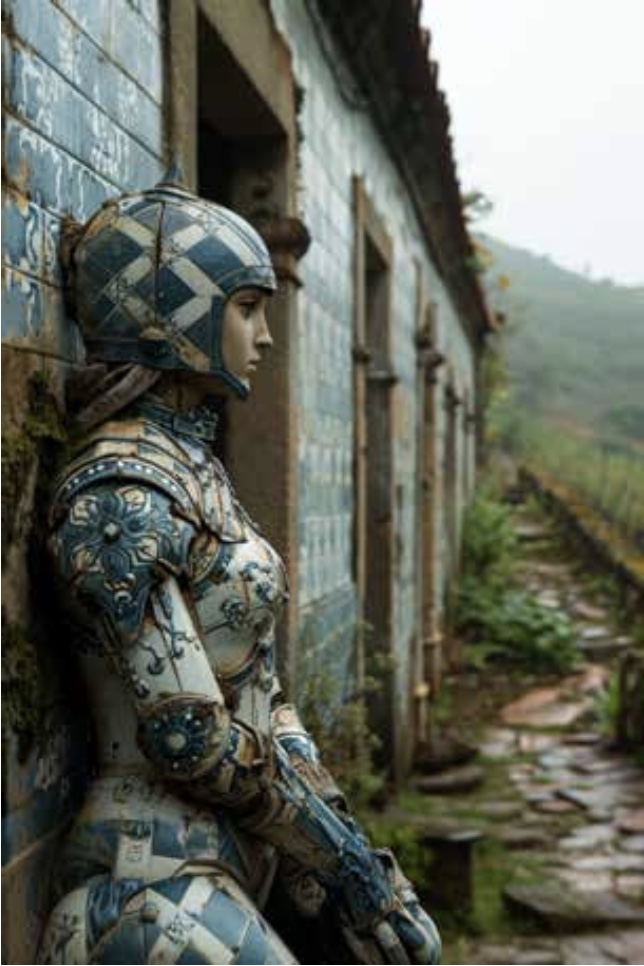
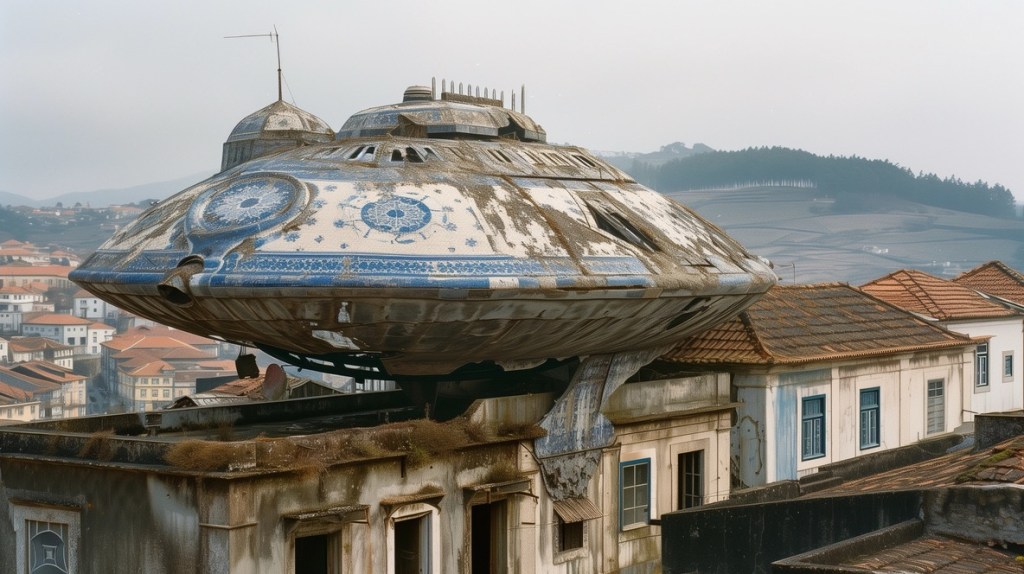
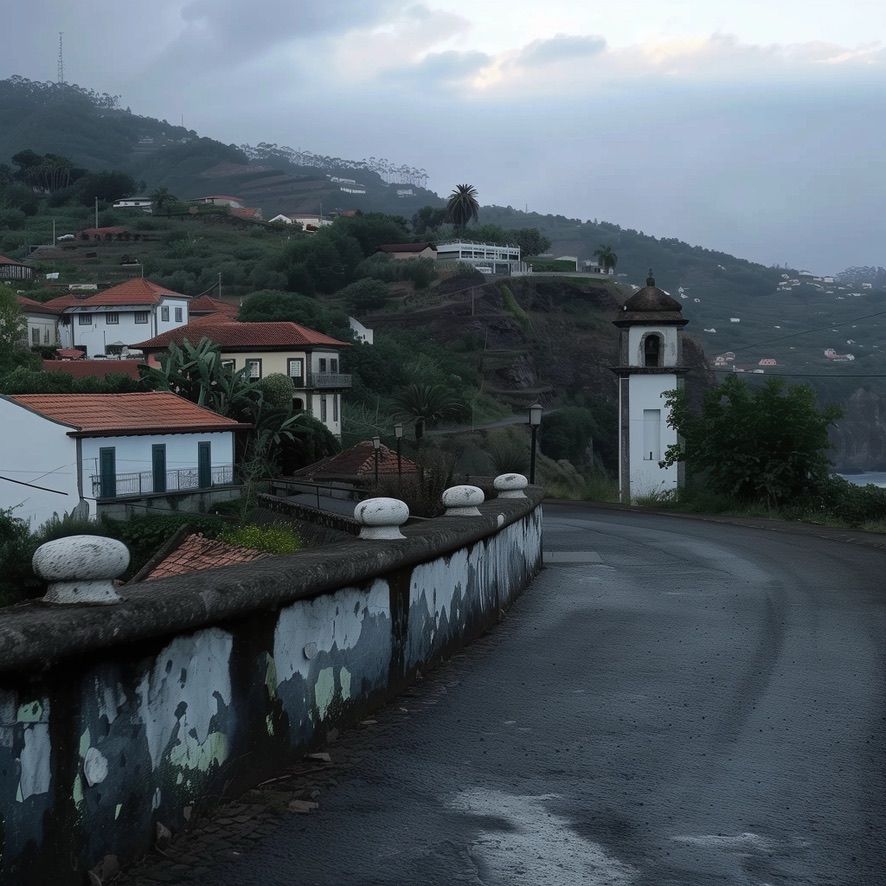
I use generative artificial intelligence to create fictional images of the Douro as an interdimensional region, intersected by extremely advanced technologies, spacecraft, and robots – yet poor, peripheral, and ruined. The aim is not to depict the region as it might have been but to construct images of what it truly is. Through fiction, I attempt to transcend stereotypes and arrive at a more fulfilling vision of a personal experience.
The most common images of the Douro are for tourists. They show picturesque landscapes, vineyards, estates, villages, towns, and small cities. However, for someone who grew up there, they neither reflect the lived experience nor the memory of the place. Like any image, they frame reality while excluding certain details: urban life, buildings in the middle of vineyards and along the riverbanks; layers of decaying technology; machines that were once new and now lie as ruins by the roadside. The tourist photograph often favours bucolic rurality, forgetting that on the slopes of the Douro one can enjoy reading science fiction, listening to electronic music, or tuning the pages of a manga or bande dessinée.
For someone like me, who grew up in the Douro region, memory is a challenge. Not that there is any lack of mechanisms – prostheses – to feed nostalgia. I follow Facebook groups dedicated to the towns where I once lived, the television series I watched as a child, some of the schools I attended, the railway lines I used, the authors I read as a kid, and collectible publications. However, this is an external, industrialised memory. Nothing can replace a family photograph that was never taken or that was lost. A place visited but with a name that has slipped from memory, with no photographs to document it. There is a relative comfort in the images of others. The holiday vacations of my own family, long before I was born, between Régua, Vila Real, and Vidago, can partially be reconstructed through a film posted on YouTube by another family who had the privilege of owning a video camera. There exists a social hierarchy measurable by access to images and their quality: some have films, others only photographs, and some have neither.
The disparity between centres and peripheries is also reflected in the number of pixels, in the quality of production. A place like New York has layers upon layers of imagery, created by films, disposable cameras, comics, graffiti artists, and more. The Douro, by contrast, has almost none of this. Jean-Luc Godard once remarked that while the Israelis had access to epic film as a cinematic genre, the Palestinians could only access the documentary genre. Jacques Rancière observed that a Palestinian comedy would be more subversive than a documentary.1 The tourist images of vineyards, cruise boats, villages, and trains are insufficient to represent the reality of those who grew up there.
No matter how objective they may seem, photographs are shaped by their framing – both what is included within the rectangle and what is excluded. When taking a photograph, one always tries to avoid the unsightly house, the architectural aberration, the rubbish, or a passer-by. The picturesque is an act of selection. I often find myself reflecting on the futility of a belvedere in the middle of a vineyard. Around every bend, the landscape is breathtaking. No photograph can fully capture it. Even less so for someone who has lived in the region. For me, images are always rarer, as they demand narratives beyond the picturesque. It is difficult to see myself reflected in the typical image produced of the Douro.
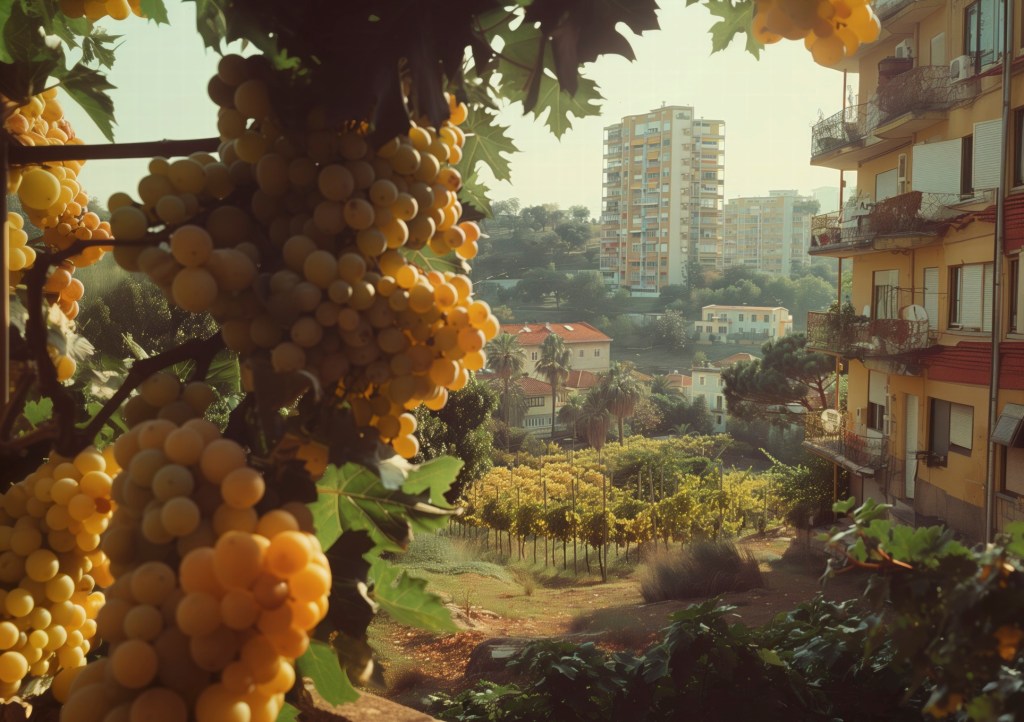
Artificial intelligence (AI) operates through stereotypes: when asked for a village in the Douro, it provides the most likely set of images someone might identify as being from the Douro. The challenge – and the opportunity – lies precisely in disrupting these clichés to achieve an image closer to reality. It is easy to produce a bucolic Douro landscape, with the river, terraces, and vineyards. The difficulty is in creating a landscape that includes buildings and urban developments among the vineyards. The resulting reality often resembles a collage because reality combines situations that seem incompatible to the photographer’s lens: the vineyard alongside urban aberrations; the throngs of tourists and the crumbling manor house. Using AI in this way is an exercise in learning to see – or rather, to reframe. It teaches realism. AI allows me to respond to my experience of the Douro in a realistic way.
The construction of memories
I use AI to construct memories. Not to reconstruct them, but to create amalgamations of factual and fictional images. The explanation may sound lofty. The reality is simpler: it is possible to construct memories on a Saturday afternoon, during a holiday, without even considering it work.
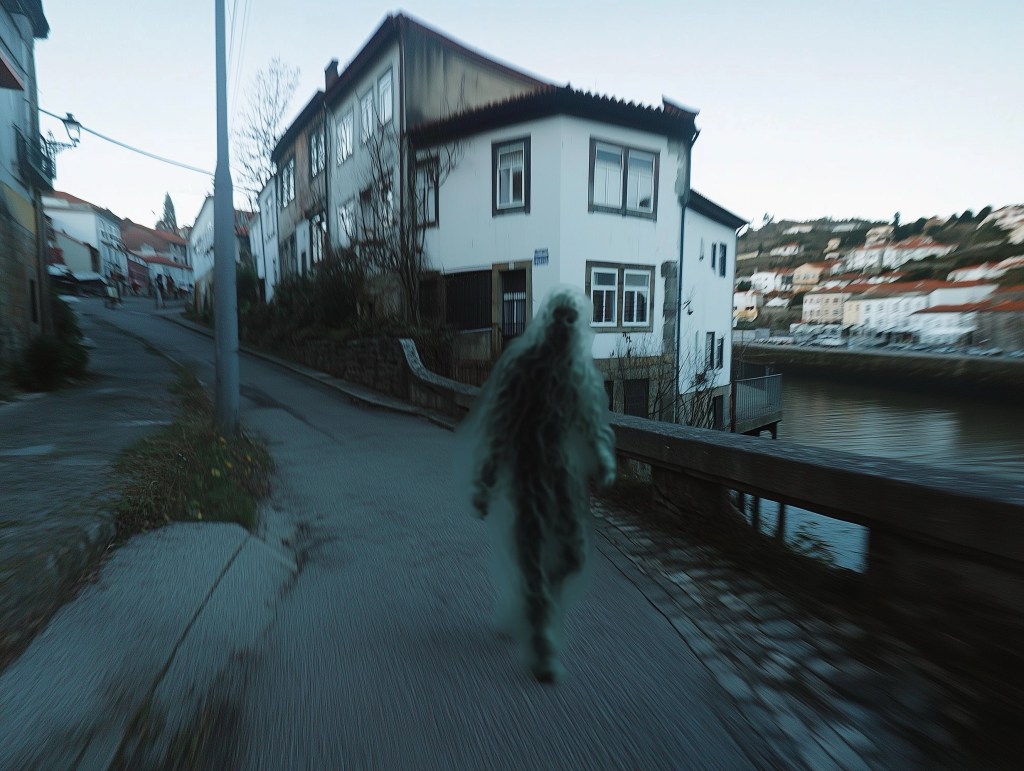
The internet has altered the nature of collective memory. It has placed unprecedented pressure on memory. We could even argue that this represents a new class distinction. Some people enjoy an abundance of memory, while others suffer from a deficit. Social media, in particular, has exacerbated inequalities in memory. Every year, more money and resources are invested in physical memory storage to preserve timelines, holiday photos, and more. Yet every year, part of this memory vanishes. A company ceases operations and its servers are shut down, or a typhoon erases the emails from an account. At the same time, forgetting has become increasingly difficult. Facebook brings back schoolmates we had long forgotten – or even those we would rather not remember. It is no longer enough to let things go; we must actively block them to forget.
Memory is now expected to be in colour and high definition. It is expected to flow continuously, like a river. For those who do not live in a central location or do not come from a family of means, personal memory is less abundant. They must make do with surrogates. Perhaps we can define centres as places where memory and nostalgia are industrially produced. Access to memory, then, might be measured by the quality of the image – or even by its mere existence.
Intervention through Images
I began experimenting with generative artificial intelligence in 2022. It would be dishonest to say that I knew what I was doing. For a long time, I treated my attempts as a hobby. Although I work in a field related to visual arts, I am not accustomed to creating images. In the past, I dabbled in comics and illustration. Today, I am a professor; I teach publication design, and a “theorist,” I write about design, mostly online. For over 20 years, I have maintained the critique blog The Ressabiator. I take seriously the role of public intellectual, as defined by Edward W. Said:2 I believe in the imperative to intervene publicly. I strive to do so in the most immediate, economical, and portable way possible. I write about design, art, architecture, politics, comics, etc. From experience, I believe that the most crucial political and civic interventions happen during spare time. It was partly the habit of intervening through blogs and social media that drew me to these images. I first encountered examples on Facebook. As with everything posted there, they were an appeal – a joke, a pun, or a provocation. Their ability to spark my curiosity, combined with the process being sufficiently economical and immediate, led me to start experimenting.
I believe the use of images for political debate and action is becoming increasingly common. Until recently, the sophisticated use of images was restricted to specialists or those with the resources to hire them. This was the paradigm of the illustrated press, cinema, and television – the mass media. Most people were considered passive spectators of a stream of images flowing from the top down. This was not entirely true, of course. The mass production of images did not prevent them from being used in a more primordial and active way. The notion of the image as a simulacrum – detached from reality, inducing alienation and passivity – is a modern one. Traditionally, images were considered endowed with life, action, and even agency. However, such ideas and uses of images are often dismissed as retrograde and primitive, associated with notions of animism and idolatry.
These “ancient” notions of the image coexist with modern ones – not on the same level, but subject to a social hierarchy. At the top, there is the image subordinated to rationality and language (the diagram, the illustration, the plan). At the bottom, there is the wild image – alive and active, considered popular, illiterate, and pagan.3 Even the widely circulated idea that images are more characteristic of capitalism4 – or more deceptive – than text betrays a fundamental iconophobia. Such perspectives reflect a logocentric elitism, where rationality and truth are associated with words, while trust in images is viewed as an excessive idolatry. Our post-Enlightenment, capitalist society is fundamentally iconoclastic. Text is the only image it accepts, but only after being stripped as much as possible of its nature as an image. An un-imagined image.
Generative artificial intelligence provokes extreme reactions, in part because of this iconophobia. It is a “living” image that generates other images: images of images (as with MidJourney and DALL-E) and – sacrilege of sacrileges – images of text (as with ChatGPT). AI, as an image endowed with agency, capable of convincingly simulating the production of words, and which is readily accessible, threatens social hierarchies and the intricate mechanisms of differentiation between literate and illiterate classes, between locals and foreigners.
The last refuge against these threats to social order is taste. AI-generated images are dismissed as kitsch, in bad taste, strange. They are not professional. But this discrimination also paradoxically ensures that these images, despite their technological origins, become vernacular, popular, even vulgar – which lends them an interventionist power similar to that of memes. There was a moment when AI-generated images could be anything. They quickly became perceived as tawdry. Part of what attracts me to the process of creating these images is the opportunity to participate in shaping a new type of taste, deciding the value and social position of images that did not exist until very recently.5
Traditionally, the written word has been the most economical means of public intervention. Modern art criticism was born out of pamphlets responding to the Salons of the king of France. With a handful of words printed clandestinely on paper, one could critique the art collection of the wealthiest man in the realm. Caricature, too, has long been a possibility. However, its creation and mass reproduction were far more complicated than text, placing it beyond the reach of most people. With social media, memes, and mobile phone cameras, public intervention through images has become as accessible as writing a text. Even without creating the image, one could share or remix images made by others. The meme is the best example. However, it has its limits. It is the visual equivalent of a cliché. With artificial intelligence, it became possible to create custom-made images. What’s more, the statistical methods underpinning their creation ensure they are almost always distinct, even when using the same prompt.
Even so, the process of creating images with AI is not straightforward. My initial (and unrealistic) expectation was that one only needed to request something, and the AI would return an interesting image, even if imperfect. One of my first attempts was to request a caricature of the space tourist Mário Ferreira, owner of the DouroAzul cruise company. As a caricature, it failed – the programme did not know what the businessman looked like. I had more success when I asked for a landscape of the Douro region’s vineyards with rockets taking off, rendered in the style of the painter J.M.W. Turner. Turner’s epic impressionism disguised the imperfections and inconsistencies. The texture of the terraces made the landscape recognisable, even when distorted. The rockets could be almost improbable collages – this only made them more evocative.
I jumped in. I spent a significant part of the next two years creating these images. I began writing a retro-futuristic mythology about the Douro as an “interdimensional demarcated zone.” Sometimes the images inspired the text; other times, I attempted to have the AI produce an image for a pre-established idea. It was always challenging. The best approach was to embrace the ambiguity of the process. Perhaps this is why I maintained the amateur aspect of the endeavour for as long as I could. Initially, I would only subscribe to MidJourney at the start of holiday periods. When I began receiving invitations to write about and showcase my experiments, I started “renting” it during work periods as well. Nevertheless, I continue to approach these experiments in the least professional way possible. They were conceived as interventions for social media, on Facebook and Instagram. These images are close relatives of memes – that is how I create them. I am interested in the “popular” creation of images on social media and their civic, political, communal, or purely aesthetic uses.
Even though the mechanisms for producing and transmitting these kinds of images are beyond the reach of the average citizen, their popular creation represents a powerful tool for public intervention. Much like social media itself, it often eludes the intentions of its creators. It is this vernacular aspect that interests me.
This text was published in Paula Melâneo, Pedro Bandeira, ed. 2025. Artificialis: A Nature das Imagens Latentes / The Nature of Latent Images. Porto: Pierrot-le-Fou.
- Fulvia Carnevale and John Kelsey, Art of the Possible: an interview with Jacques Rancière, Artforum [website], 2017. ↩︎
- Edward W.Said, Representações do intelectual: As Palestras de Reith de 1993, Lisbon, Colibri, 2000. ↩︎
- See: Horst Bredekamp, Ymago 2016, and David Freedberg, The Power of Images: Studies in the History and Theory of Response,
University of Chicago Press, 1991. ↩︎ - See: Situationist International. ↩︎
- See: Andrew Dewdney, Forget Photography, Goldsmiths Press, 2021. ↩︎
 Unseen by Design
Leave a comment