
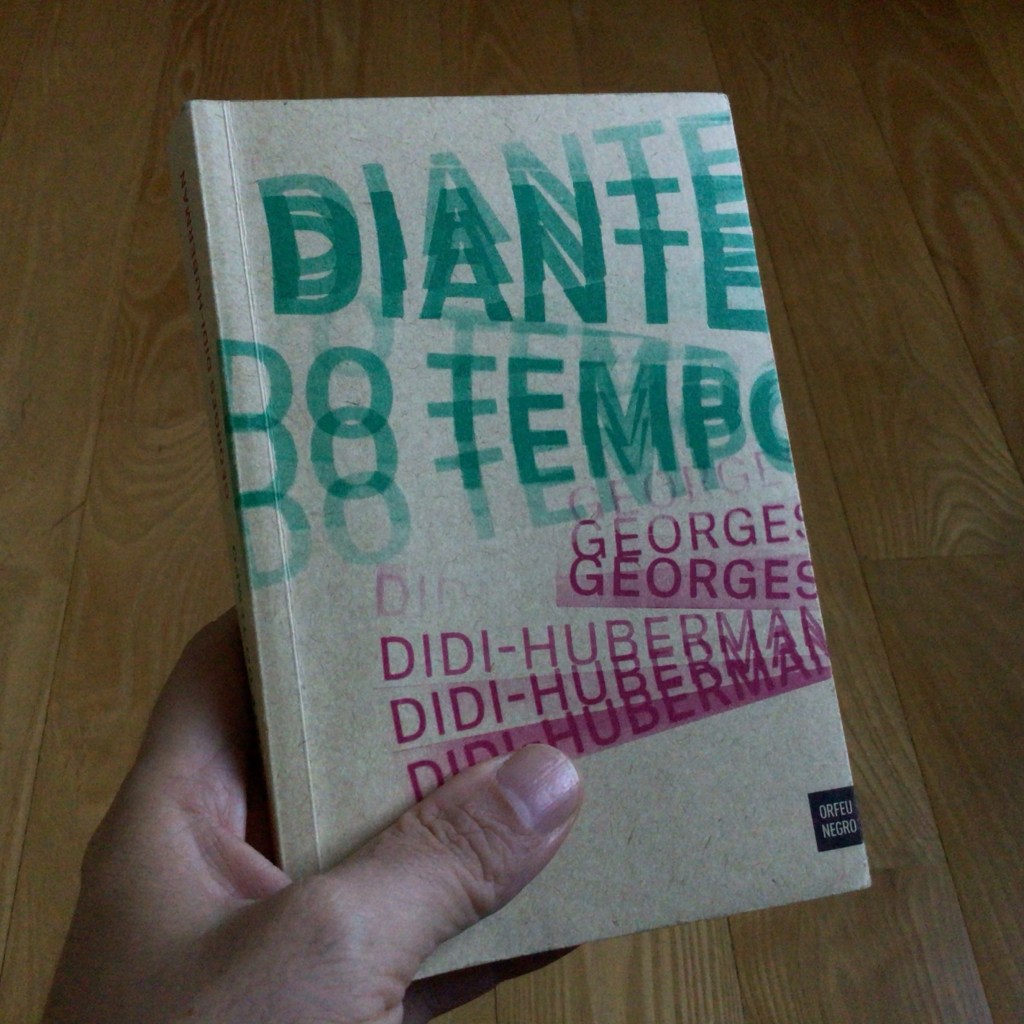
This is one of the books I like the most. It was given to me under unusual circumstances. In 2017, I went to the Orfeu Negro headquarters in Lisbon to finalize the details of the book that would become ‘O Design que o Design Não Vê’ (The Design That Design Doesn’t See). It didn’t have that title yet; it had a clever working title that, fortunately, I was persuaded to change.
During that meeting, we discussed how to format the text, write the notes, and compile the bibliography. Carla took this book, ‘Diante do Tempo,’ from the shelf and gave it to me as an example. I thought it would be unlikely for me to read it. At the time, I was more interested in intersectional theory. Didi-Huberman was, to me, a recurring cliché in the discourse of the arts. I knew nothing about him.
By that time, I was already avidly following the work of Forensic Architecture. The group was investigating human rights violations using innovative design methods borrowed from architecture. In contrast, design, even the most political, seemed stuck. There was a debate about whether critical design was possible or not. Forensic Architecture was already doing it.
The problem was how to draw lessons from their very specific, localized work and make it a general case applicable to other areas like graphic design.
The solution, for me, lay in images. Forensic Architecture’s work was based on the use of the latest theories of image and photography as conceptual tools. The damage caused by a bomb to a building was seen and interpreted as if it were photographic records—or more accurately, iconographic.
From there, I moved on to ‘Imagens Apesar de Tudo’ (Images in Spite of All) by Didi-Huberman, about images produced in operational extermination camps.
And from that point, I jumped to what currently interests me: the role of images and visuality in design. Although graphic design is associated with images, it is increasingly centered on text and typography. It’s an apparent paradox that has preoccupied me.
I’ve been studying examples of non-textual and non-typographical graphic design. From there, I jumped back to ‘Diante do Tempo,’ where Didi-Huberman deals with a non-figurative painting produced by Fra Angelico.
When I left the Orfeu office with that book in my backpack, I walked to the bus terminal near the Jardim Zoológico and took the bus to Sines. I went to see Susana, who was pregnant with Rosa and setting up an exhibition at the Centro Emérico Nunes. During that short break, I read ‘Racismos’ by Francisco Bethencourt. It was already pointing to the visual nature of racism. But Didi-Huberman remained in my backpack, waiting for me to grow enough to pick it up.
(translated using chat GPT)
 Unseen by Design
Leave a comment