
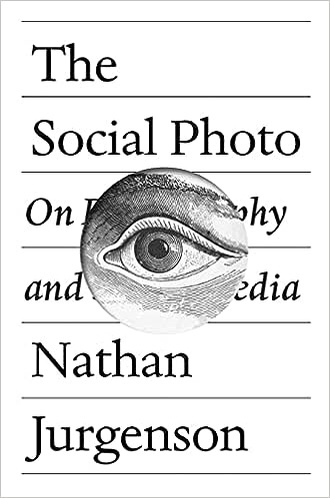
I just reread “The Social Photo: On Photography and Social Media” by Nathan Jurgenson.
The title says it all: it’s about the social image, which is no longer just representation, nor can it be evaluated by the standards of artistic or documentary photography. It’s an image that serves to communicate within a network, living on walls, threads, and stories.
It’s a book I like, though not in the way critics usually employ the expression. My relationship with it lies in the realm of emotions. I don’t agree with everything it says. There are better works on the topic. I hadn’t even come to that subject through it. I had been mulling over it for some time. However, it was the first book where it was laid out clearly and informally.
I’ve never been convinced by the argument that an image represents capitalism more than a word does. The abundance of images doesn’t necessarily mean we’re moving away from reality. Beyond all the capitalist exploitation and fake news, there are uses of social media and images that are fruitful.
It’s hard for me to advocate for an ecologically and post-capitalist future devoid of an abundance of images. I like images. I like their abundance.
Appropriately, I came across “The Social Photo” because of its cover. The black and white captivated me, the almost classical arrangement of typography, and the Victorian engraving of an eye partially covering the text. A more modernist designer might complain that the occlusion impedes reading. Crystal goblets, etc.
However, within design, the obsession with text and transparency hinders the awareness of vision – the vision of vision. Within the classical design framework, it’s assumed that reading is fragile and must be protected at all costs. But protected from what? Perhaps from the abundance of images, which brings with it the revelation that the text itself is just another image among the others.
That’s what the Victorian eye overlaying the text does. It contaminates the classical typography and reveals its nature as an image.
(Translated from Portuguese via Chat GPT)
 Unseen by Design
Leave a comment