
I have been reading many reactions to the death of Sinéad O’Connor. They never touch on an important aspect of her work.
One of Miguel Esteves Cardoso’s recent columns is an example of this omission. He writes that we don’t really want to “get to know the artist behind the work. […] We like the work. In this case, the songs.”
It’s interesting that Mec needs to point out that O’Connor’s work is her music. It’s not that obvious. Any pop musician is also an artist of image. Mec almost admits it a few paragraphs later when he says:
“We only care about the puppet. And the puppet was a very young girl, as beautiful as her voice, with huge eyes and a shaven head, crying while singing Nothing Compares 2 U.”
So, while the music is indeed the work, the image is just the “puppet.” By image, I mean the music video, but also the clothes, the haircut, and the makeup. It’s not possible, no matter how austere one wants to be, to separate the music from all of this, especially in the 80s and 90s. The “puppet” is also the work and a powerful part of it.
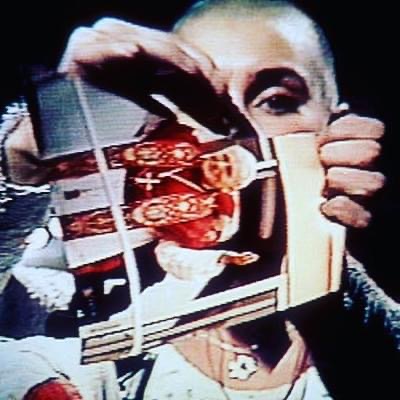
Much has been said about when O’Connor tore the photograph of the Pope. However, little has been said about the form that act took. Many artists are said to be iconoclasts. Sinéad O’Connor was one of the few who were literally so. She tore the image of a religious leader. The impact was greater than if she had simply verbally condemned the Pope or even written a song on the same theme.
It was a powerful act because it struck at the heart of the power of images. People tend to speak of images as “puppets,” “superficialities,” things that don’t hold much power. And if they have power, it’s because they represent capitalism or manipulations of propaganda. Serious people don’t let themselves be swayed by images.
An American university professor, when wanting to show his students the power of images, proposes an experiment: cut the eyes out of a photograph of their mothers.
The power of images is older and deeper than one might think. Especially for us today, who are all very rational, expressing our rationality through words and discourse.
An important part of religion is dictating the morality of images: what can or cannot be represented and how, what operations an image can perform, and what functions images have.
Iconoclasm is a religious act, applied mainly to the religions of others: a Catholic doesn’t burn his own Bible but the sacred book of another religion. The violence of religion is often violence against the images of others. Religion takes the image very seriously.
Hence the impact of Sinéad O’Connor’s act, tearing a religious image. It is significant that a week later, on the same TV program where she tore the image, Joe Pesci, identifying himself as a Catholic and Italian, brought the same photo, glued back together. The icon was restored. Pesci said he would have slapped O’Connor if he had witnessed the act.
The omission I was talking about is that Sinéad O’Connor was also an artist and, by extension, a person through her image. Because people are also defined by their image. Not just artists, but regular people too.
Not even just religious people, as there is a belief that religious people are primitive and that’s why they take images so seriously. Any person. Proof of this is that her courage in destroying that image is praised. Behind all the rationality and distance from superstition, it is understood that an image is not destroyed because it is indifferent, but because it deeply hurts others.
(translated by ChatGPT)
 Unseen by Design
Leave a comment